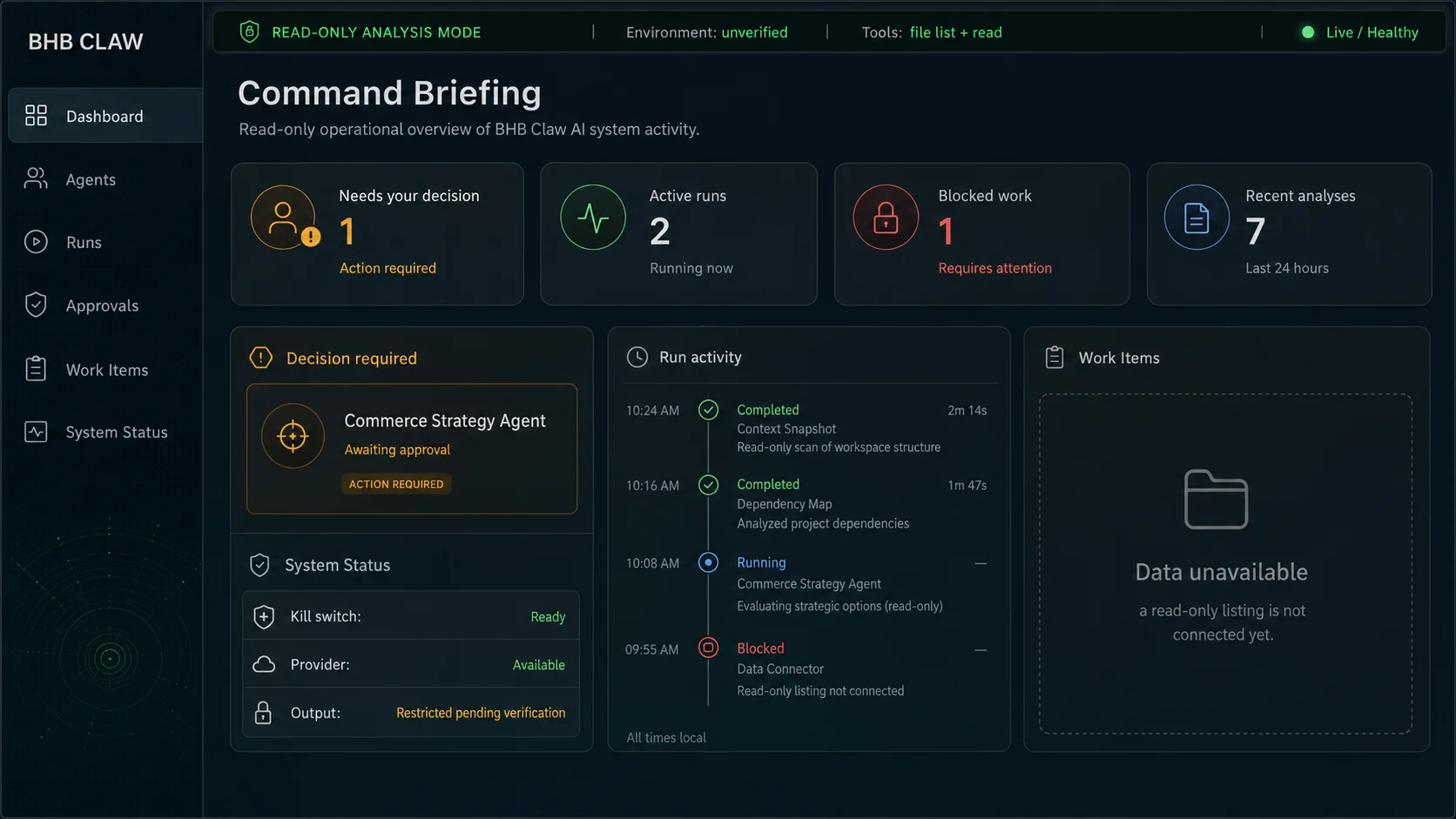
Agent Command Center
Agent Command Center is a private AI orchestration environment exploring how specialized agents can collaborate on development, auditing, research, and productivity workflows.
Role
Creator / Architect
Visibility
Private system with public concepts
Visual overview and artifact readiness
Agent Command Center visual overview
Primary public-safe visual surface. This can be replaced with a real screenshot, diagram, dashboard, or mockup when available.
Recommended: 1600x1000 WebP, PNG, or SVG
Project status
Private development with public-safe conceptual presentation
Brian's role
Creator / Architect
Technology
AI workflows, AI agents, Automation systems, Software architecture, Productivity systems
Artifact readiness
Prepared for real screenshots, diagrams, dashboards, and product mockups
What this work demonstrates.
What it is
Agent Command Center is a private AI orchestration environment exploring how specialized AI agents can collaborate across development, auditing, research, and productivity workflows.
Why it exists
Modern work increasingly spans technical execution, research, review, planning, and communication. The project explores how those workflows can become more structured without removing human judgment.
Current stage
Private development with public-safe conceptual presentation
Brian's role
Creator / Architect
The operating problem behind the work.
AI-assisted work can become fragmented as tasks move across chats, notes, repositories, research threads, review passes, and follow-up actions.
Many AI tools are optimized for a single assistant, prompt, or conversation. That is useful, but complex work often needs specialized roles, shared context, clear review paths, and a way to coordinate multiple workflows.
Explore a command-center model that treats AI assistance as an operating system for work: structured, visible, reviewable, and guided by a human operator.
How the system was framed.
The system is framed around multi-agent thinking: specialized AI roles, structured workflow stages, human oversight, and practical output review. The goal is not to make AI feel magical; it is to make AI-assisted work easier to coordinate, inspect, and use responsibly.
Architecture decisions
- Present the public case study as a conceptual orchestration environment rather than a technical implementation walkthrough.
- Use system concepts that explain agent roles, workflow lifecycles, and approval paths without exposing private systems.
- Keep the visual language close to premium technical documentation so the work feels practical, calm, and executive-ready.
Workflow decisions
- Treat development, auditing, research, and productivity as distinct workflow families with different review needs.
- Make human approval a visible part of the workflow instead of implying unsupervised automation.
- Separate reusable workflow concepts from private experiment notes and internal operating details.
Tradeoffs
- The public story needs to show serious system thinking while keeping implementation specifics private.
- The command-center metaphor is useful only if it supports clarity, oversight, and practical execution rather than theatrical AI language.
- Artifact language should signal the future proof-of-work path without pretending screenshots already exist.
Visual system maps prepared for future real assets.
These public-safe system concepts show how the project is intended to be explained: an agent ecosystem, a workflow lifecycle, and a human approval flow. They are concept surfaces for future diagrams, not disclosures of private implementation.
Agent ecosystem diagram
A public-safe concept map for the public concept of specialized agents collaborating across development, auditing, research, and productivity workflows.
01
Operator intent
frames work
02
Shared context
routes context
03
Specialized agents
returns output
04
Review layer
approves next step
05
Work artifacts
Workflow lifecycle diagram
A public-safe concept lifecycle for moving a public-safe workflow from intake through context, agent work, review, and documented outcome.
01
Intake
define scope
02
Context setup
prepare inputs
03
Agent pass
inspect output
04
Review
record result
05
Outcome
Human approval flow
A public-safe concept approval model showing that the operator remains responsible for judgment, release decisions, and sensitive boundaries.
01
AI draft
requires inspection
02
Human review
checks boundaries
03
Risk check
decides path
04
Approve or revise
operator controlled
05
Publish or execute
Technology, tools, and methods behind the work.
Technology
Frameworks
Tools
Methods
Discovery, design, build, and iteration path.
01
Discovery
Frame the problem around growing work complexity, fragmented AI usage, context loss, and the need for reviewable execution.
02
Concept Development
Shape the public-safe concept around specialized agent roles, workflow families, and operator-grade visibility.
03
Architecture Exploration
Explore agent ecosystem, workflow lifecycle, and human approval concepts without exposing internal systems.
04
Prototype Development
Continue private prototyping while keeping public artifacts conceptual, redacted, or public-safe.
05
Future Evolution
Add public-safe visuals, expanded workflow examples, and integration concepts when they can be shared responsibly.
Why choices were made, what changed, and where the system goes next.
Position the project as a private orchestration environment.
That communicates the system-level intent more accurately than framing it as a chatbot, prompt library, or public SaaS product.
Use conceptual diagrams before public screenshots.
The project can show how Brian thinks about agents, workflows, and oversight without publishing private implementation details.
Make human approval part of the system story.
Trust, security awareness, and practical usefulness matter more than implying autonomous execution.
Design principles
Lessons learned
- AI workflow design is a product design problem, an operating discipline, and a trust problem at the same time.
- Specialized agent roles are most useful when the workflow makes context, review, and next action explicit.
- A public case study can be credible when it clearly marks what is conceptual, what is private, and what future artifacts are needed.
Future roadmap
- Explore additional agent capabilities for development, auditing, research, and productivity workflows.
- Expand workflow automation concepts while keeping human approval and review boundaries visible.
- Create productivity enhancements that help organize context, decisions, and follow-up actions.
- Evaluate integration opportunities only when they can be documented without exposing private systems.
Prepared surfaces for real proof of work.
Screenshots, diagrams, dashboards, mobile previews, and product mockups can be dropped into this gallery as public-safe assets become available.

Primary Hero Artifact
Purpose
Introduces the flagship product surface and shows how workflow state, agent activity, and review context can be presented at an executive level.
Public-safe operator dashboard visual showing the case study's command-center interface direction.
Public-safe explanation
The visual is presented as a public-safe product artifact and should not be treated as a disclosure of private prompts, internal tasks, credentials, or real productivity data.
Asset: public/projects/agent-command-center/operator-dashboard.webp
Recommended: 1600x1000 WebP
Architecture Diagram
Purpose
Illustrates the conceptual relationship between specialized AI agents, orchestration, shared context, and human oversight.
Public-safe architecture diagram explaining the high-level relationship between operator intent, orchestration, specialized agents, review, and approved output.
Public-safe explanation
The diagram is conceptual and intentionally avoids private implementation details, infrastructure specifics, prompt structure, credentials, and internal workflow names.
Asset: public/projects/agent-command-center/architecture-diagram.svg
Recommended: SVG preferred, 1600px minimum width if exported as WebP
Agent Workflow
Purpose
Shows how a public-safe workflow can move from intake through context setup, specialized agent work, review, and documented outcome.
Public-safe workflow lifecycle diagram showing how agent-supported work moves through planning, building, review, approval, execution, and learning.
Public-safe explanation
The workflow uses generic stage labels and does not expose private workflow text, client or company context, or internal automation logic.
Asset: public/projects/agent-command-center/agent-workflow.svg
Recommended: SVG preferred, 1600px minimum width if exported as WebP
Human Oversight
Purpose
Explains how human judgment, review checkpoints, risk awareness, and approval boundaries remain part of the orchestration model.
Public-safe human oversight flow showing how review, risk awareness, approval, execution, and feedback remain operator controlled.
Public-safe explanation
The flow shows approval concepts and decision gates only. It does not publish sensitive review criteria, security procedures, audit details, or private operating rules.
Asset: public/projects/agent-command-center/approval-flow.svg
Recommended: SVG preferred, 1600px minimum width if exported as WebP